Iron-rich foods for women: best sources and absorption
The best iron-rich foods for women, how heme and non-heme iron differ, and simple ways to absorb far more iron from everyday meals.

Written and evidence-checked by the VeriNourish Editorial Team against 5 named sources listed below. No licensed clinician reviews this content.
Iron is one of the nutrients women are most likely to fall short on. Monthly periods, pregnancy, frequent blood donation and heavy endurance training all raise the risk of low iron, particularly during the reproductive years.
Food can prevent most shortfalls and keep your stores healthy. But the amount printed on a label is only part of the story: the form of iron, the rest of the meal, and your current iron status all change how much your body actually absorbs.
This guide compares the most useful iron-rich foods, explains heme and non-heme iron, and shows how to build meals that make plant iron far easier to absorb. It also covers when food alone is unlikely to be enough.
Heme versus non-heme: why the source matters
Dietary iron comes in two forms, and your body treats them very differently.
- Heme iron comes from meat, poultry and seafood. It is absorbed well and steadily, and is barely affected by the rest of the meal.
- Non-heme iron comes from beans, lentils, tofu, nuts, seeds, vegetables, grains and fortified foods. It is absorbed less easily, and how much you get depends heavily on what you eat alongside it. Vitamin C improves it; phytates and some polyphenols reduce it.
Two meals can list the same amount of iron yet deliver very different amounts to your body. That does not make plant iron ineffective. It means meal composition matters far more when most of your iron comes from plants. As a rough guide, overall absorption is around 14 to 18 percent from mixed diets that include meat, seafood and vitamin C, compared with about 5 to 12 percent from vegetarian diets.
How much iron do women need?
Iron needs change with age and life stage.
| Life stage | Recommended daily intake |
|---|---|
| Girls aged 14–18 | 15 mg |
| Women aged 19–50 | 18 mg |
| Pregnancy | 27 mg |
| Breastfeeding, 19–50 | 9 mg |
| Women aged 51 and over | 8 mg |
These are guideline amounts for generally healthy women. Needs can be higher with heavy periods, an established deficiency, frequent blood donation or another cause of ongoing loss. Vegetarians are estimated to need about 1.8 times these amounts, because non-heme iron is absorbed less well. That is a population planning figure, not a personal prescription. Our iron intake calculator applies both adjustments for you.
The best iron-rich foods
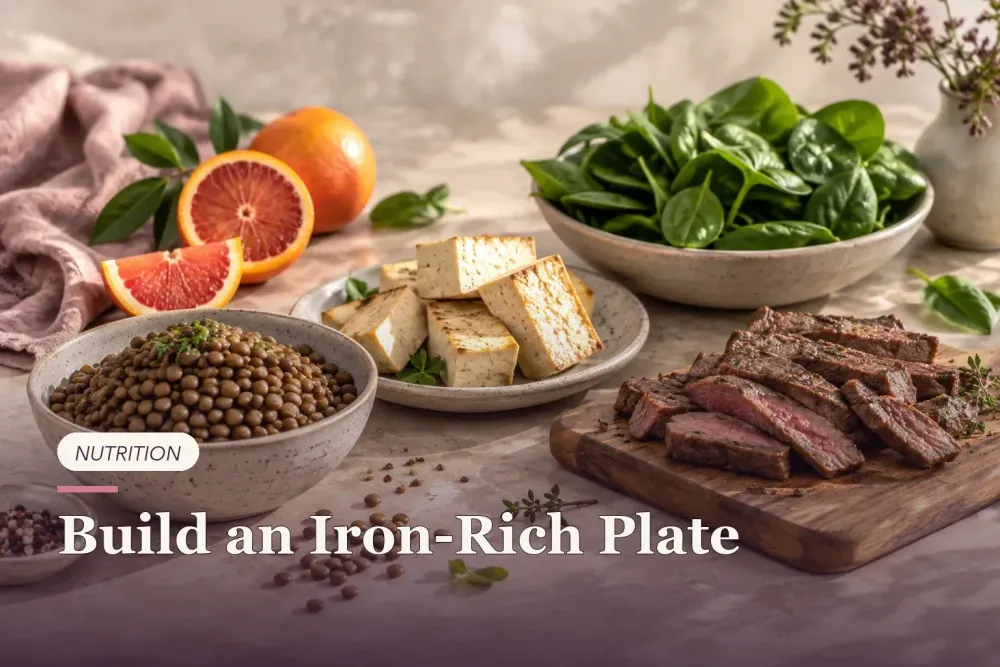
Rather than chasing one "superfood", build meals around a variety of reliable sources. The figures below are approximate and come from the NIH food table; brands and serving sizes vary, especially for fortified foods.
| Food and serving | Approximate iron | Type | Note |
|---|---|---|---|
| Fortified breakfast cereal, one serving | up to 18 mg | Non-heme | Varies hugely; check the label |
| Oysters, cooked, 85 g | 8 mg | Heme | One of the richest everyday seafoods |
| Canned white beans, about 180 g | 8 mg | Non-heme | A practical high-iron staple |
| Beef liver, pan-fried, 85 g | 5 mg | Heme | Very rich, but avoid in pregnancy (vitamin A) |
| Lentils, cooked, 100 g | 3 mg | Non-heme | High in fiber; pairs well with tomato or lemon |
| Spinach, cooked, 90 g | 3 mg | Non-heme | Iron is present, but poorly absorbed |
| Firm tofu, 125 g | 3 mg | Non-heme | Also a useful protein source |
| Canned kidney beans, 125 g | 2 mg | Non-heme | Works in chili, salads and bowls |
| Canned sardines, 85 g | 2 mg | Heme | Also provides protein and omega-3 |
| Chickpeas, cooked, 80 g | 2 mg | Non-heme | Good in curries, salads and hummus |
| Braised beef, 85 g | 2 mg | Heme | Better absorbed than plant sources |
| Cashews, 30 g | 2 mg | Non-heme | Handy, but not enough to carry the day alone |

Fortified cereal can look like the obvious winner, but the real amount depends entirely on the product, so read the label rather than assuming. Spinach deserves a more realistic reputation: it contains iron, but compounds called oxalates limit how much you absorb, so a bowl of lentils or beans usually does more in practice. And liver, though exceptionally rich in iron, should be avoided in pregnancy, because it is very high in preformed vitamin A, which can harm the baby.
How to absorb far more iron
Getting more iron is not only about eating more of it. For plant-based meals especially, a few habits change how much you actually take in.
Pair non-heme iron with vitamin C
Vitamin C sharply improves non-heme iron absorption within a meal, and a normal serving of fruit or veg does the job. Useful combinations:
- lentil soup with a squeeze of lemon;
- bean salad with peppers and tomatoes;
- fortified cereal with kiwi or strawberries;
- tofu stir-fry with broccoli and peppers.
Keep tea and coffee for between meals
The polyphenols in tea and coffee reduce non-heme iron absorption when you drink them with food. You do not need to give them up. When iron matters, leave an hour or two between an iron-rich meal and your cup. This matters most when most of your iron is from plants, or your stores are already low.
Mind the timing of calcium supplements
Calcium can reduce iron absorption when taken at the same time, though its long-term effect on iron status looks small in healthy people. If you take separate calcium and iron supplements, take them at different times. There is no need to cut back on dairy foods because of this.
Add a little meat, poultry or seafood, if it suits you
A modest amount of meat or fish improves the absorption of non-heme iron eaten in the same meal. A large portion is not needed, and vegetarian meals still provide useful iron when they include reliable sources plus vitamin C.
What helps and what holds iron back
| Improves non-heme absorption | Reduces it within the same meal |
|---|---|
| Citrus, peppers, tomatoes, berries, kiwi | Tea and coffee |
| Broccoli and other vitamin C sources | Separate calcium supplements taken together |
| A little meat, poultry or seafood | Large amounts of phytate-rich bran |
The foods on the right are not unhealthy. Wholegrains, pulses, dairy, tea and coffee all belong in a good diet. Timing and the overall pattern matter far more than trying to strip out every compound that touches iron.
A one-day iron-rich day
An example, not a treatment plan, spreading iron across the day:
- Breakfast: fortified wholegrain cereal (check the label) with strawberries or kiwi; or porridge with pumpkin seeds and berries.
- Lunch: lentil and tomato soup with wholegrain bread, plus a salad with peppers and a lemon dressing.
- Snack: roasted chickpeas with an orange, or hummus with sliced peppers.
- Dinner: lean beef with potatoes and broccoli; or tofu with rice, broccoli and peppers; or a bean chili with tomatoes. For seafood, choose sardines, mussels or oysters.

Who needs to pay closer attention
- Heavy periods are the most common reason women run low. If every cycle leaves you exhausted, breathless or lightheaded, more iron-rich food helps, but the bleeding itself also deserves assessment.
- Pregnancy raises needs to about 27 mg a day. This has its own rules, covered in our guide to iron in pregnancy, and iron is part of some prenatal vitamins when a blood test shows it is needed.
- Vegetarian and vegan diets can provide enough iron, but consistency matters: beans, lentils, tofu, seeds and fortified foods need to appear regularly, with vitamin C alongside.
- Endurance athletes and frequent blood donors lose more iron and often need a higher intake, sometimes with testing.
What the research says
Dietary changes can improve iron intake and, in some women, iron status. The approaches that work best combine regular iron-rich foods with meal choices that improve non-heme absorption, such as adding vitamin C. But studies vary a lot in design and in participants' starting levels, and the evidence is stronger for preventing shortfalls than for correcting an established deficiency with food alone. A systematic review of dietary treatment trials in women shows how varied that literature is, with studies defining iron deficiency at cut-offs anywhere from 15 to 40 (Nutrients, 2022). The cast iron question follows the same pattern: a review of 13 studies found laboratory tests consistently showed more iron in food cooked in iron pots, especially acidic dishes, but only 4 of 9 clinical trials found a real rise in hemoglobin (Nepal J Epidemiol, 2021).

Food first does not mean food only
For a healthy woman without deficiency, iron-rich meals are the right foundation, and they bring protein, zinc, B vitamins and fiber that a tablet cannot. An established deficiency is different. Low ferritin or iron-deficiency anemia can reflect heavy periods, gut blood loss, poor absorption or pregnancy, and diet supports treatment without always fixing it quickly enough on its own.
Do not take high-dose iron because tiredness "sounds like low iron". Fatigue, breathlessness and hair shedding have many causes, and unnecessary iron can cause side effects. The useful next steps are in our guides to the ferritin blood test, iron deficiency and iron supplements: test first, then treat.
The bottom line
- Women aged 19–50 need about 18 mg of iron a day; pregnancy raises it to 27 mg.
- Heme iron (meat, seafood) is absorbed more readily; plant iron depends on the rest of the meal.
- Oysters, white beans, fortified cereals, liver, lentils and tofu are among the richest everyday sources.
- Pair plant iron with vitamin C, and keep tea and coffee for between meals when your stores are low.
- Do not avoid dairy; only the timing of separate calcium and iron supplements needs care.
- Food prevents most shortfalls, but a confirmed deficiency usually needs testing and treatment.
If tiredness, breathlessness or hair shedding continue despite a better diet, ask your doctor about testing rather than guessing from symptoms.
Frequently asked questions
What foods are highest in iron?
Among everyday foods, fortified cereals, oysters, white beans and liver provide the most iron per serving. Other strong sources include lentils, tofu, kidney beans, chickpeas, sardines, beef and cashews. Heme iron from meat and seafood is absorbed more readily than non-heme iron from plants.
Can women get enough iron from a vegetarian or vegan diet?
Yes, with planning. Plant-based diets rely on non-heme iron, which is absorbed less readily, so vegetarians are estimated to need about 1.8 times more overall. Eat beans, lentils, tofu, seeds and fortified foods regularly, and pair them with vitamin C, while keeping tea and coffee for between meals.
How can I absorb more iron from food?
Pair non-heme iron with vitamin C such as citrus, peppers, tomatoes, kiwi or berries. Keep tea and coffee for between meals, since they reduce absorption. If you take separate calcium and iron supplements, take them at different times. A little meat or fish also boosts the iron you absorb from plants in the same meal.
Does cooking in a cast iron pan add iron?
It can. Wet, acidic foods such as tomato sauce may pick up some iron from cast iron cookware, but the amount varies widely with the food, cooking time and the pan. Treat it as a possible small bonus, not a treatment for low iron.
When do I need an iron supplement instead of food?
When a blood test confirms low iron or iron-deficiency anemia, especially if there is ongoing blood loss. Food still helps, but an established deficiency usually needs treatment and investigation rather than diet alone. Test before supplementing rather than taking iron on spec.
References
- Iron: Fact Sheet for Consumers · NIH Office of Dietary Supplements
- Iron: Fact Sheet for Health Professionals · NIH Office of Dietary Supplements
- Effectiveness of dietary interventions to treat iron-deficiency anaemia in women · Nutrients, 2022
- Foods to avoid in pregnancy · NHS
- Effect of cooking food in iron-containing cookware on increase in blood hemoglobin level: a systematic review · Nutrients, 2022