Protein for women: how much you need for strength
How much protein women need for strength and muscle, what the training evidence actually shows, and how to spread it across the day to get the most from it.


Written and evidence-checked by the VeriNourish Editorial Team against 7 named sources listed below. No licensed clinician reviews this content.
If you do regular resistance training and are otherwise healthy, 1.2 to 1.6 g of protein per kg of body weight a day is a sensible range to aim for. General adult reference intakes sit lower, around 0.75 to 0.83 g per kg a day, but those are adequacy benchmarks for the population, not muscle-gain targets (EFSA, British Dietetic Association).
One group this range is not for: anyone with kidney disease or on a medically prescribed diet. Protein needs in kidney disease depend on kidney function and dialysis status, so get individual advice first (University Hospitals Sussex NHS Foundation Trust).
And before you buy anything, know this: extra protein does not build strength on its own. Training drives the adaptation; protein just makes sure a shortage isn't what limits it. Everything below hangs on that distinction.
How much you actually need
Where does the 1.6 come from? A meta-analysis that pooled 49 resistance-training studies with 1,863 people found that average gains in fat-free mass stopped increasing once total protein reached about 1.62 g per kg a day. The breakpoint itself was estimated imprecisely, with a confidence interval running from 1.03 to 2.20, which is why we'd call 1.6 a reference point, not a physiological ceiling (British Journal of Sports Medicine, 2018).
In other words: 1.6 g per kg is a practical target for a healthy woman who lifts, not a physiological limit and not a quota.
| Your weight | General adult reference, ~0.8 g/kg | Upper strength target, 1.6 g/kg |
|---|---|---|
| 55 kg (121 lb) | 44 g | 88 g |
| 65 kg (143 lb) | 52 g | 104 g |
| 75 kg (165 lb) | 60 g | 120 g |
| 85 kg (187 lb) | 68 g | 136 g |
Our protein calculator takes your weight and activity level and returns a daily range plus a per-meal figure. Pregnancy and breastfeeding push the requirement higher still, but that's territory for your midwife, not a calculator.
What extra protein is actually worth
Something, just much less than the marketing suggests.
In that same pooled analysis, adding protein on top of resistance training improved one-rep-max strength by 2.49 kg and fat-free mass by 0.30 kg compared with training alone. Both effects held up statistically. Both are modest. And the fat-free-mass benefit shrank as participants got older.
Keep the causality straight: the exercise produces the adaptation, and protein's job is to stop a shortage from capping it. Doubling your intake will not double anything.
The finding that matters most after menopause
Read this one before spending money on powder.
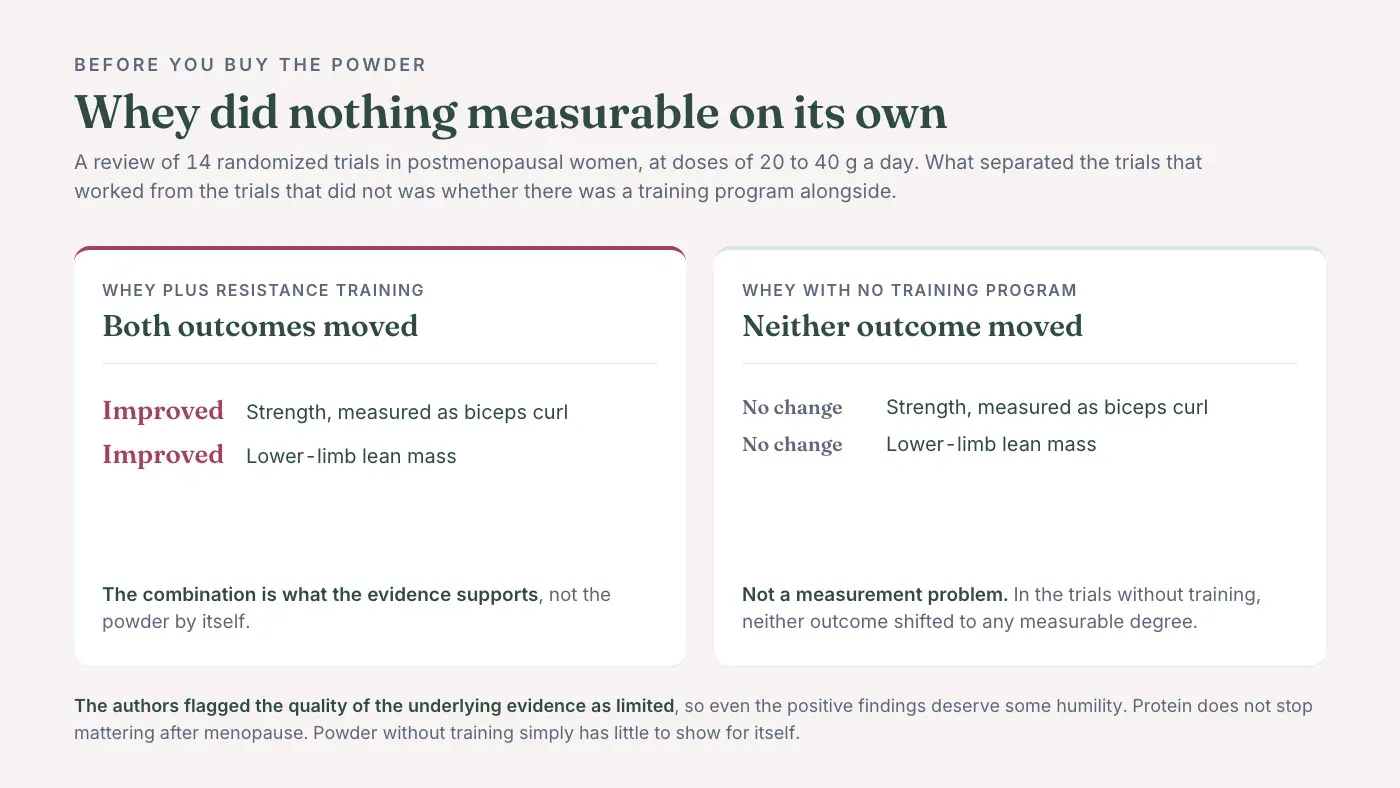
A review of 14 randomized trials in postmenopausal women found that whey protein improved strength (measured as biceps curl) and lower-limb lean mass only when it was combined with resistance training. In the trials without a training program, whey moved neither strength nor lean mass to any measurable degree (Nutrients, 2022). Doses across the studies ran from 20 to 40 g a day, and the authors flagged the quality of the underlying evidence as limited, so even the positive findings deserve some humility.
The takeaway isn't that protein stops mattering after menopause. It's that powder without training has little to show for itself, while the combination does.
And how much do older women need day to day? A cross-sectional study of 281 women (mean age 70) found that intakes at or above 1.17 g per kg a day went along with higher relative skeletal muscle mass, though being observational it can't prove that eating more preserves muscle, only that the two travel together (Nutrients, 2021). Around perimenopause and menopause, holding on to muscle gets harder and more important at the same time; strength training and, for some women, creatine attack the same problem from the training side.
Spread it through the day
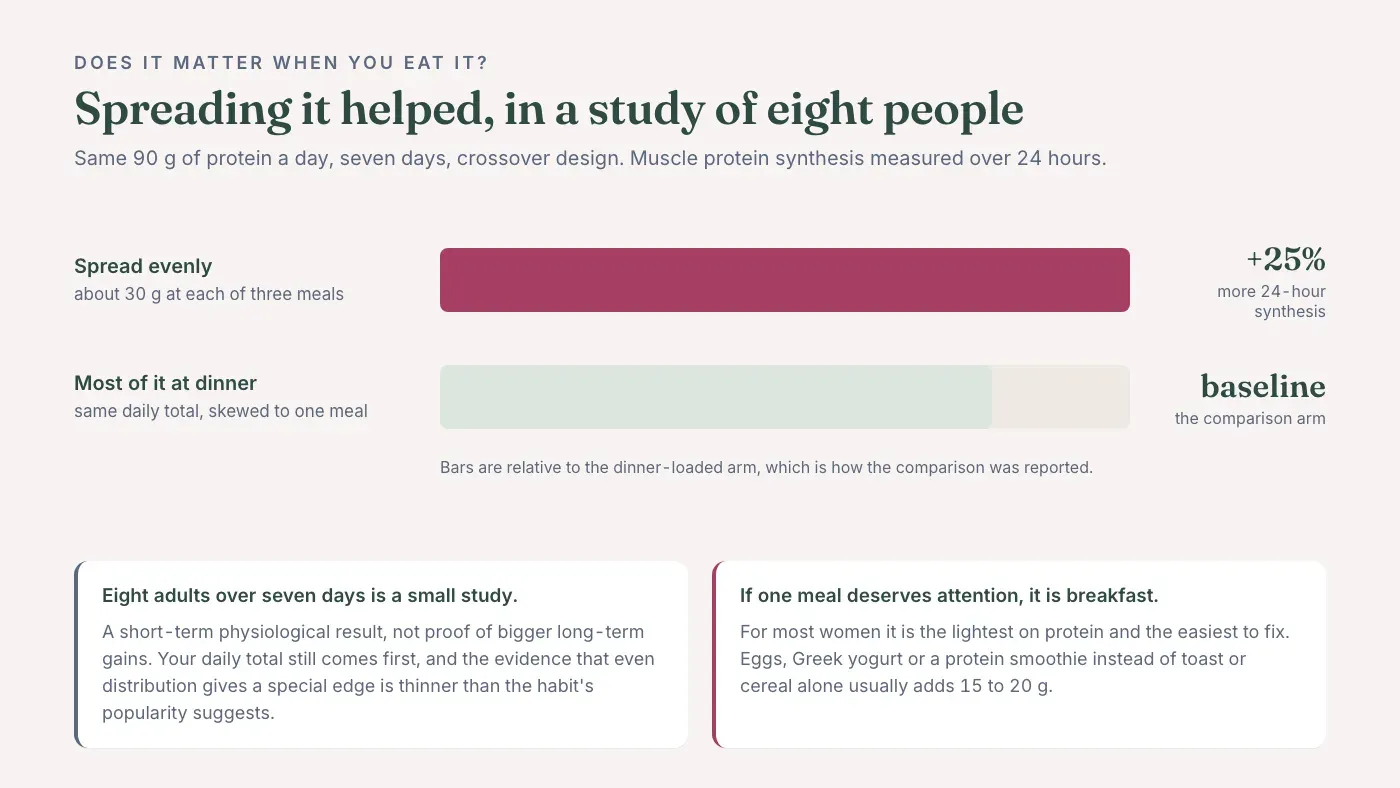
Total daily intake comes first. After that, putting protein in every meal is a sensible habit, though the evidence that even distribution gives you a special edge is thinner than the habit's popularity suggests.
The study usually cited is small: eight adults, seven days, crossover design. Spreading the same 90 g of daily protein evenly, about 30 g per meal, produced 25% more 24-hour muscle protein synthesis than loading most of it into dinner (Journal of Nutrition, 2014). That's a short-term physiological result, not proof of bigger long-term gains.
Still, if one meal deserves attention, it's breakfast, which for most women is the lightest on protein and the easiest to fix.
How much protein is in common foods
Approximate amounts in a realistic portion:
| Food | Protein |
|---|---|
| 100 g cooked chicken breast | ~30 g |
| 120 g cooked salmon | ~25 g |
| 150 g Greek yogurt | ~15 g |
| 150 g cooked lentils | ~13 g |
| 2 eggs | ~12 g |
| 100 g firm tofu | ~12 g |
Use the table to build meals containing roughly 25 to 30 g. Exact amounts vary by product, preparation and portion size.
Animal and plant protein
Both work. Animal foods are complete proteins, carrying all the amino acids the body can't make, while most single plant foods run low in one or two. Variety across the day solves it: beans, lentils, tofu, wholegrains, nuts and seeds, which bring fiber along for free. There's no need to combine them at the same meal.
If you are choosing between powders, or wondering whether collagen counts, that is a separate question with its own answers: protein sources compared covers how sources are scored for quality, what happened when whey and soy were matched for leucine, and how much bigger a plant scoop needs to be.
Easy ways to get enough
- Fix breakfast first. Eggs, Greek yogurt or a smoothie with protein instead of toast or cereal alone. This single change usually adds 15 to 20 g.
- Anchor each meal with fish, chicken, lean meat, tofu, beans or lentils, and sanity-check it against the table above.
- Pair protein foods with fiber-rich plants for a more balanced meal.
- Make snacks count: nuts, yogurt, edamame or cheese.
The bottom line
Three numbers cover most of it for an otherwise healthy woman who lifts: 1.2 to 1.6 g per kg a day in total, 25 to 30 g at each meal as an easy way to spread it, and muscle-strengthening work at least twice a week.
That last item carries the others. The strongest evidence for gaining strength and lean mass belongs to adequate protein plus resistance work, not to either alone. If you only change one meal this month, make it breakfast. If you can manage two changes, the second one is the training.
Frequently asked questions
How much protein does a woman need for strength?
If you lift regularly and are otherwise healthy, aim for somewhere between 1.2 and 1.6 g per kg of body weight a day. For a 65 kg woman, that's roughly 80 to 105 g. The 1.6 figure comes from pooled training studies where extra protein stopped adding muscle beyond that point, though the estimate was imprecise. Treat it as a practical reference point, not a line you must hit.
Is 0.8 g per kg enough?
It's enough to prevent deficiency in most healthy adults. That's what the reference intake is designed for. It was never meant as a muscle-building target. Regular strength training, and older age, both shift the useful range upward, though how much depends on your health, activity and the rest of your diet.
Does protein build muscle without exercise?
Not meaningfully. Adequate protein helps you keep the muscle you have, but in a review of trials in postmenopausal women, whey only improved strength and lower-limb lean mass when paired with resistance training. Taken without training, it moved neither.
How much difference does extra protein actually make?
A real difference, but a small one. Across dozens of pooled training studies, supplementing protein added roughly 2.5 kg to one-rep-max strength and a third of a kilo of fat-free mass on top of what training alone delivered. The lifting does the heavy lifting; protein just keeps a shortage from getting in the way.
How should I spread protein through the day?
Hit your daily total first. That matters most. Beyond that, putting protein in every meal is sensible: one small study found that spreading 90 g evenly over three meals produced 25% more muscle protein synthesis over 24 hours than saving most of it for dinner. A short-term lab finding, not proof of bigger long-term gains, but an easy habit with no downside.
Do I need a protein powder?
No. It's a convenience, not a requirement, and most women can get there from food with a bit of planning. Where powder genuinely helps is when you're training and consistently falling short of the target from meals. Which, not coincidentally, is exactly the situation the trials were testing.
References
- A systematic review, meta-analysis and meta-regression of the effect of protein supplementation on resistance training-induced gains in muscle mass and strength in healthy adults · British Journal of Sports Medicine, 2018
- Effect of whey protein supplementation in postmenopausal women: a systematic review and meta-analysis · Nutrients, 2022
- Dietary protein requirement threshold and micronutrients profile in healthy older women based on relative skeletal muscle mass · Nutrients, 2021
- Dietary protein distribution positively influences 24-h muscle protein synthesis in healthy adults · The Journal of Nutrition, 2014
- EFSA sets population reference intakes for protein · European Food Safety Authority, 2012
- Sport and exercise nutrition · British Dietetic Association
- Dietary protein intake for chronic kidney disease · University Hospitals Sussex NHS Foundation Trust