Night sweats in women: causes, relief and when to worry
Waking up drenched? The causes of night sweats in women, how to tell the hormonal ones apart from the rest, what helps, and the warning signs to check.

Written and evidence-checked by the VeriNourish Editorial Team against 7 named sources listed below. No licensed clinician reviews this content.
Waking up damp, throwing off the covers, then feeling chilled an hour later: night sweats are exhausting, and in midlife they are usually the menopause transition announcing itself. They are not only that, though. Cycle-linked sweats, the weeks after giving birth, a new prescription and an overactive thyroid all produce the same drenched sheets.
The sweat itself does not tell you which one you have. What comes with it does.
How to tell which cause you are dealing with
Work through this before assuming anything. Most women recognize their own pattern in one or two rows.
| Likely cause | What tends to come with it |
|---|---|
| Perimenopause or menopause | You are in your 40s or 50s, cycles have changed or stopped, daytime flashes, broken sleep |
| Cycle-linked hormone changes | Sweats arriving on roughly the same days each cycle, usually the week before a period, settling once it starts |
| Pregnancy, or the weeks after birth | You are pregnant or recently gave birth; heaviest in the first fortnight, then fading |
| Breast cancer hormone therapy | Started within months of beginning tamoxifen or an aromatase inhibitor |
| Anxiety or stress | Racing thoughts at night, tension, sweats on the bad nights rather than every night |
| Overactive thyroid | Feeling hot all the time, racing heart, unexplained weight loss, shaky hands |
| A medicine you started | The timing lines up with a new drug: antidepressants, steroids, some painkillers |
| Infection | Fever, feeling unwell, a cough, a recent or lingering illness |
| Sleep apnea | Loud snoring, gasping, pauses a partner notices, daytime sleepiness |
| Alcohol in the evening | Sweats on drinking nights, often with waking in the early hours |
| Low blood sugar overnight | You are treated for diabetes and get hypos at other times too |
| A warm room or heavy bedding | Sweats that stop once you change the bedding or open a window |
The NHS also says plainly that sometimes the cause of night sweats is not found (NHS). That is worth knowing before you spiral: unexplained does not mean sinister, particularly when nothing else is wrong.
The hormonal causes, and how they differ
Perimenopause and menopause
This is the big one in midlife. Vasomotor symptoms, the umbrella term for hot flashes and night sweats, affect 60 to 80% of women during or after the menopause transition (Am J Physiol Heart Circ Physiol, 2022). As estrogen falls and swings, the brain's temperature control tightens: the range of body temperature you tolerate without reacting narrows, so ordinary warmth reads as too hot and triggers a flush and a sweat. During the day these are hot flashes. At night they wreck your sleep.
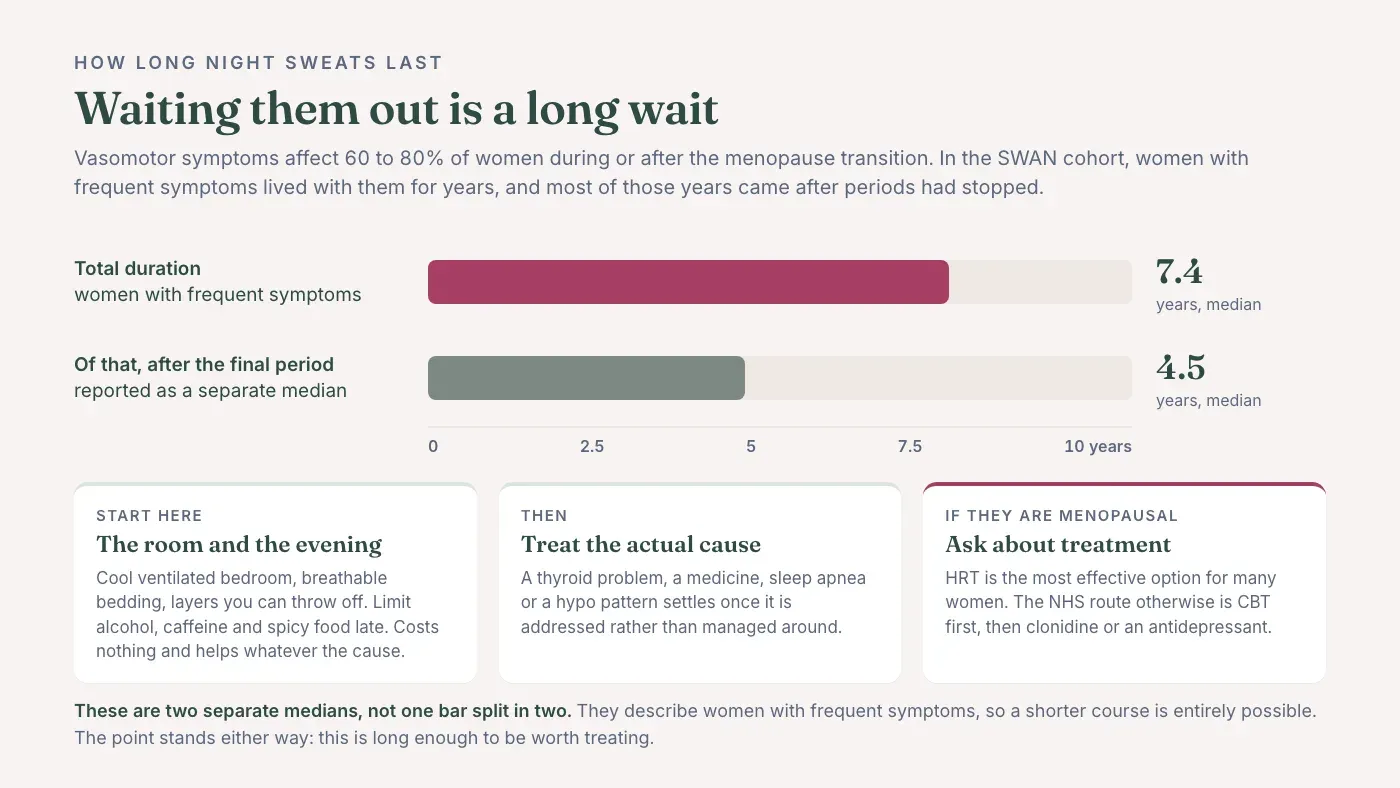
They do not stop at menopause either, and they run longer than most women are told. In the SWAN cohort, women with frequent symptoms had them for a median of 7.4 years, and a median of 4.5 of those years fell after the final period (JAMA Internal Medicine, 2015). Our perimenopause guide sets out how to tell which stage of the transition you are in from your bleeding pattern, which is more informative than your age.
The week before your period
Hormone shifts across the menstrual cycle are a recognized cause in their own right (Cleveland Clinic). If your sweats land in the luteal phase, alongside the other things PMS brings, and clear when bleeding starts, that timing is the answer. It can happen at any age with a regular cycle and does not mean the transition has begun.
Pregnancy and the months after birth
Vasomotor symptoms can also occur during pregnancy and after birth. In a study that followed 429 women through pregnancy and the year after delivery, 35% reported hot flashes during pregnancy and 29% after birth. These figures describe hot flashes, not the prevalence of night sweats. The postpartum peak came at two weeks, when 20% reported them, falling to 14% by twelve weeks and 10% at a year (Fertility and Sterility, 2013). Cleveland Clinic frames the postpartum sweats as hormone levels returning to baseline.
Breast cancer hormone therapy
Tamoxifen and aromatase inhibitors drop estrogen deliberately, and sweats follow. Among 104 premenopausal women starting tamoxifen, the proportion reporting hot flashes and sweating rose from 38.5% before treatment to 86.5% within three to six months, and more than 47% rated their symptoms moderate to extremely severe (Frontiers in Oncology, 2022). If this is you, raise it with your oncology team rather than quietly stopping the drug. There are ways to manage it.
The causes that have nothing to do with hormones
The NHS lists anxiety, medicines including antidepressants, steroids and painkillers, low blood sugar, alcohol or drug use, and hyperhidrosis, the condition of sweating more than the body needs to (NHS). Cleveland Clinic adds infections, an overactive thyroid, sleep apnea and, less commonly, blood cancers such as lymphoma and leukemia.
Other symptoms can make a non-hormonal cause more important to investigate. Fever, unexplained weight loss or an illness that will not clear are reasons to get checked.
If the thyroid picture fits, a TSH test is a quick way to settle it.
Night sweats at 40: is this perimenopause starting?
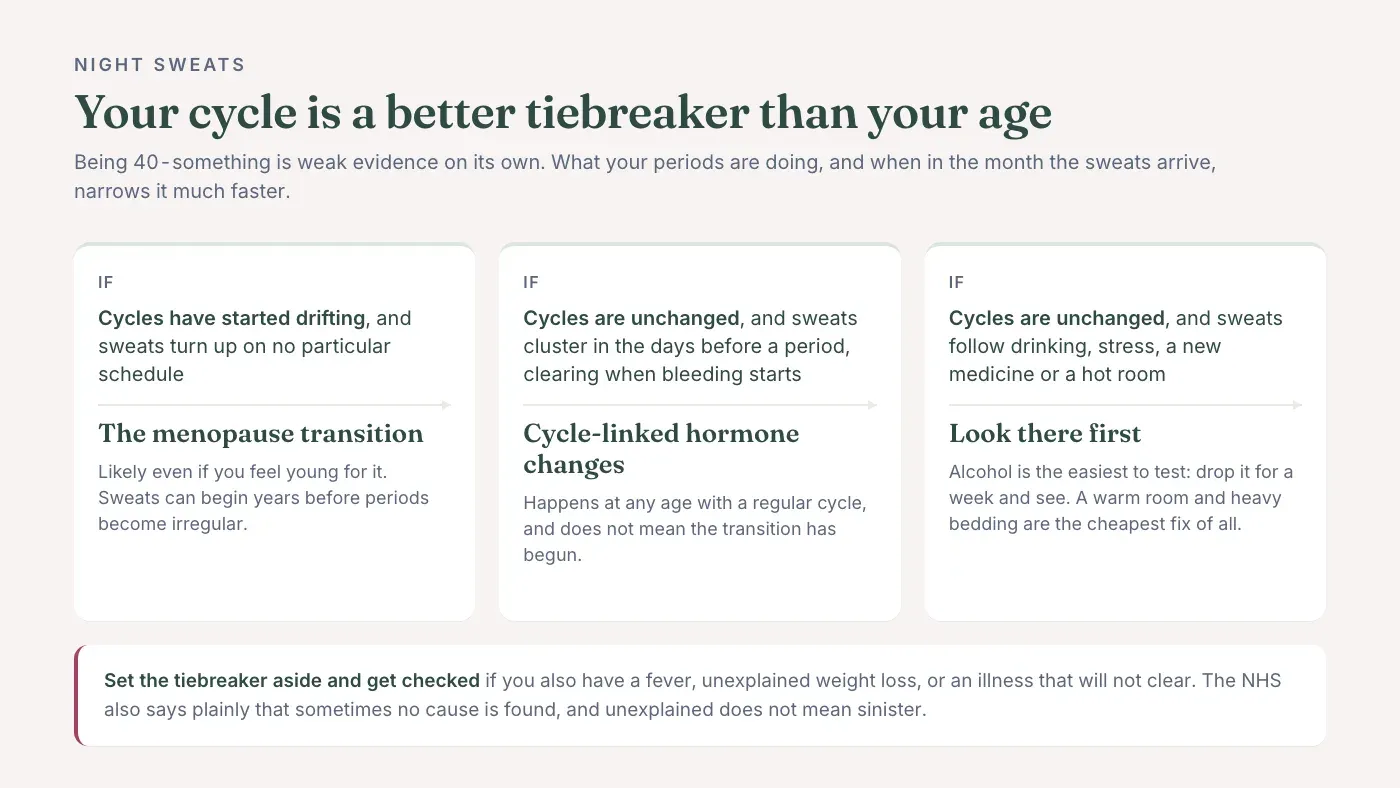
Sometimes yes, and it is one of the earlier signs. But age alone is weak evidence, so use your cycle as the tiebreaker.
- Cycles have started drifting and sweats are turning up on no particular schedule: the menopause transition is the likely explanation, even if you feel young for it.
- Cycles are unchanged and sweats reliably cluster in the days before a period: cycle-linked hormone changes are a more likely explanation.
- Cycles are unchanged and sweats follow drinking, stress, a new medicine or a hot room: look there first.
Sweats can also begin years before periods become irregular, which is exactly the group SWAN found had the longest overall course. If yours started early, it is worth treating properly rather than waiting them out.
What helps
Start with the room and the evening, since those changes cost nothing and work for every cause.
- Cool the sleep environment. A cool, ventilated bedroom, breathable natural-fiber bedding and nightwear, layers you can throw off, and water within reach.
- Adjust evening habits. Limit alcohol, caffeine and spicy food close to bedtime. Alcohol is worth testing on its own for a week, because it is one of the easiest causes to confirm and remove.
- Protect the sleep itself. Night sweats and poor sleep feed each other, and broken sleep makes everything else in the transition harder to tolerate.
- Treat the underlying cause. A thyroid problem, a medicine, sleep apnea or a hypo pattern settles once it is addressed rather than managed around.
- Consider treatment for menopausal sweats. HRT is the most effective option for many women, and menopause-specific cognitive behavioral therapy can sit alongside it or replace it when HRT is unsuitable or unwanted. The NHS route is CBT first, and if that does not help, clonidine or an antidepressant (NHS). Newer non-hormonal drugs exist too, so ask a clinician what is available to you.
When to see a doctor
The NHS advises seeing a GP if you have night sweats regularly that wake you or worry you, if you also have a very high temperature or feel hot, cold or shivery, a cough or diarrhea, or if you are losing weight for no reason (NHS).
Add to that any drenching, repeated sweats with no clear cause, sweats with unexplained weight loss or lasting fatigue, and the simple case of wanting treatment for menopausal sweats. Effective options exist, and years of broken sleep is not something to put up with on principle.
Frequently asked questions
Are night sweats always menopause?
No, though it is one of the common explanations in midlife. Vasomotor symptoms, the term covering hot flashes and night sweats, affect 60 to 80% of women during or after the menopause transition. Anxiety, some medicines, infection, an overactive thyroid, sleep apnea, low blood sugar and alcohol all cause them too, and the NHS notes that sometimes no cause is found.
What causes night sweats in women who are not near menopause?
Cycle-linked hormone changes in the days before a period, pregnancy and the weeks after birth, anxiety, a new medicine such as an antidepressant or a steroid, an overactive thyroid, infection, alcohol, low blood sugar overnight, and sleep apnea. A too-warm bedroom is a common and harmless cause worth ruling out first.
How long do menopausal night sweats last?
Longer than most women expect. In the SWAN cohort, women with frequent hot flashes and night sweats had them for a median of 7.4 years in total, and a median of 4.5 of those years came after the final period. Women whose symptoms started early tended to have them longest.
Can night sweats be linked to my menstrual cycle?
Yes. Cleveland Clinic lists hormone changes across the menstrual cycle among the causes. The clue is timing: sweats that turn up on roughly the same days each cycle, usually in the week before a period, and settle once bleeding starts.
Do breast cancer treatments cause night sweats?
Often. In a study following 104 premenopausal women on tamoxifen, the share reporting hot flashes and sweating rose from 38.5% before treatment to 86.5% within three to six months of starting. This is worth raising with your oncology team rather than stopping treatment, since there are ways to manage it.
When should I worry about night sweats?
See a doctor if you have night sweats regularly that wake you or worry you, if you also have a very high temperature, a cough or diarrhea, or if you are losing weight for no reason. Drenching, repeated sweats with no clear cause deserve assessment.
References
- Vasomotor symptoms of menopause, autonomic dysfunction, and cardiovascular disease · American Journal of Physiology, 2022
- Duration of menopausal vasomotor symptoms over the menopause transition · Avis NE et al, JAMA Internal Medicine, 2015
- Night sweats · NHS
- Treatment for menopause and perimenopause · NHS
- Night sweats · Cleveland Clinic
- Prospective evaluation of hot flashes during pregnancy and postpartum · Fertility and Sterility, 2013
- Hot flushes and sweating during the first 24 months of tamoxifen therapy · Frontiers in Oncology, 2022