What 1,461 US magnesium supplement labels show
A census of 1,461 US magnesium labels: doses, serving sizes, common forms, and how many list more than the 350 mg adolescent and adult upper limit.


Written and evidence-checked by the VeriNourish Editorial Team against 3 named sources listed below. No licensed clinician reviews this content.
Magnesium is one of the easiest supplements to buy badly. The bottles look interchangeable, the number on the front is large, and the things that decide how the supplement behaves are printed small on the back.
So we read a defined label population rather than a convenience sample: every record marked on-market in the US government database whose product name contains magnesium and whose ingredients list magnesium. That query returned 1,488 records, of which 1,461 declare elemental magnesium in milligrams and form the basis of everything below.
What we found
| Finding | Result |
|---|---|
| Median elemental magnesium per serving | 250 mg |
| Median per day, as the label directs | 300 mg |
| Range across the census | 1 mg to 2,100 mg per serving |
| Servings above the 350 mg adolescent and adult supplemental upper limit | 477 of 1,461 (32.6%) |
| Label-directed days above that adolescent and adult limit | 574 of 1,448 (39.6%) |
| Products where a serving is more than one unit | 848 of 1,461 (58.0%) |
| Labels naming no magnesium source at all | 92 of 1,461 (6.3%) |
| Most commonly named form | Oxide, 514 labels (35.2%) |
| Second | Citrate, 499 labels (34.2%) |
| Glycinate or bisglycinate | 303 labels (20.7%) |
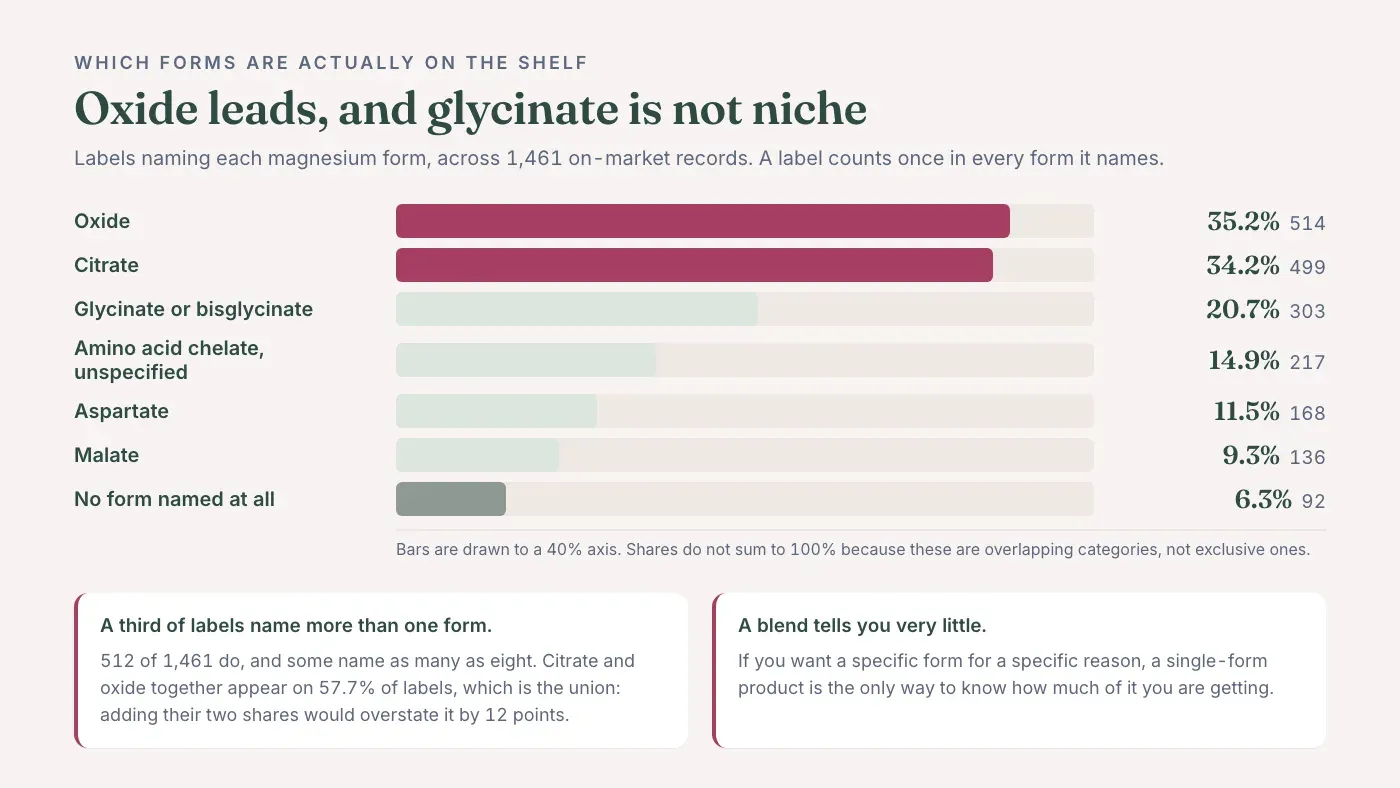
Form shares do not sum to 100%, because 35% of labels name more than one form and some name as many as eight. A label counts once in each form it mentions.
Two in five labels list more than the adult limit
The US tolerable upper intake level for magnesium from supplements is 350 mg a day for adolescents and adults. The reference intake documents are specific about its scope: the ULs "represent intake from a pharmacological agent only and do not include intake from food and water" (DRI summary tables). Magnesium in food is not counted against it. Children have lower age-specific upper limits.
Here the serving and the day part company, which is why we measured both. 477 labels put more than 350 mg in a single serving. 574 direct you past it over a full day, once you take the number of servings the label itself tells you to take. The daily figure is the one that describes what happens if you follow the instructions.
This is not a poisoning story. The limit is set mainly on the risk of diarrhea, nausea and abdominal cramping. The NHS uses a different kind of statement for a different purpose, saying that "having 400mg or less a day of magnesium from supplements is unlikely to cause any harm" (NHS). That is consumer reassurance rather than a second formal upper limit, and the two should not be read as competing thresholds.
What the numbers do mean is practical. Loose stools are the usual first sign of too much, and plenty of women blame something else in their diet.
The dose on the front is often not one capsule
On 848 of 1,461 labels, a serving is more than one unit. Two capsules, three tablets, a scoop of powder.
The large number on the front is the serving, not the pill. A bottle promising 400 mg where a serving is two capsules delivers 200 mg per capsule, and a woman who takes one is at half the dose she thinks. Nothing here is deceptive; the arithmetic is on the panel. It is simply arithmetic almost nobody does in a shop.
That also cuts the other way. Where a serving is several units, taking fewer whole units is a straightforward way to come down. Do not assume a tablet can be split accurately or that a capsule can be split at all.
The shelf does not match its reputation
Two things surprised us here, and both cut against the way the category is usually described.
Oxide is the most common form, not citrate. Oxide appears on 35.2% of labels and citrate on 34.2%, close enough that the ordering could shift with a different definition, but nowhere near the gap the aisle's marketing implies.
Glycinate is not niche. It is on 20.7% of labels, one in five, which is roughly double what its positioning as a specialist choice would suggest.
The other thing worth knowing is how often a label names several forms at once. A third do, and a "magnesium complex" naming five or six salts tells you very little about how much of any one of them you are getting. Where you want a specific form for a specific reason, a single-form product is the only way to know what you have.
| Form | Labels naming it | Share |
|---|---|---|
| Oxide | 514 | 35.2% |
| Citrate | 499 | 34.2% |
| Glycinate or bisglycinate | 303 | 20.7% |
| Amino acid chelate, unspecified | 217 | 14.9% |
| Aspartate | 168 | 11.5% |
| Malate | 136 | 9.3% |
| No form named | 92 | 6.3% |
What the forms do differently is a separate question with a thinner evidence base than the packaging suggests, which our glycinate versus citrate guide works through.
How we did this, so you can repeat it
The census rests on the NIH Dietary Supplement Label Database, which publishes manufacturers' own label data through a public API (DSLD v9). No purchases, no samples, no laboratory.
- Queried the database for on-market records (
status=1) whose product name contains magnesium and which list magnesium as an ingredient, synonyms applied. - Sorted by product name and paged through to exhaustion, so this is a complete enumeration of that population rather than a ranked slice. That returned 1,488 records.
- For each, read the full label record: elemental magnesium per serving, the serving size in units, the stated servings per day, and every magnesium source named in the product name or the structured ingredient data.
- Dropped 27 records with no elemental magnesium figure in milligrams, leaving 1,461.
Repeating the analysis on one row per unique brand, product, dose and serving size, 1,141 rows, moves the headline figures by less than half a percentage point, so the duplicate label versions in the database are not driving the result.
Check it yourself. The full dataset carries one row per label with its DSLD id, and the metadata file records the exact query, the extraction timestamps and every exclusion.
Four limits, stated plainly. This is a United States database and a large share of our readers are in the UK, where the shelf differs. "On market" is a status flag in the database, not a check that a product was for sale this week, so these are label records rather than a retail census. The population includes combination products and products marketed to children, so comparison with 350 mg is descriptive against the adolescent and adult UL, not an age-specific safety assessment. And we read labels: we did not test a capsule, so nothing here says whether the contents match the declaration.
What to do with this in a shop
- Find the elemental magnesium line, not the compound weight on the front. Our magnesium guide explains the difference.
- Check the serving size, then the servings per day. Both are larger than one more often than you would guess.
- If you want a specific form, buy a single-form product. A third of labels name several, and a blend tells you nothing about the split.
- Add up everything you take. For adolescents and adults, the 350 mg limit covers all supplements and medicines together, so a magnesium capsule on top of a multivitamin or an antacid must be counted alongside them.
Frequently asked questions
How much magnesium is in a typical supplement?
Across 1,461 on-market magnesium labels in the US database, the median serving contained 250 mg of elemental magnesium and the median label-directed day came to 300 mg. The spread is enormous, from 1 mg to 2,100 mg per serving. The number on the front is not always the number in one capsule, because 58 percent define a serving as more than one unit.
How many labels list more than the adult upper limit?
Among these labels, 32.6 percent list more than 350 mg in a serving and 39.6 percent direct more than 350 mg over a full day. The 350 mg US upper limit applies to supplemental magnesium for adolescents and adults, not magnesium from food. Child upper limits are lower, and a label comparison is not an individual safety assessment.
Which magnesium form is most common?
Oxide, named on 35.2 percent of labels, just ahead of citrate on 34.2 percent. Glycinate appears on 20.7 percent, considerably more than its reputation as a niche choice suggests. These shares do not add up to 100 because 35 percent of labels name more than one form, and some name as many as eight.
Do magnesium labels tell you which form you are buying?
Usually. On 6.3 percent of labels no magnesium source was named anywhere in the product name or the ingredient data. Most of those are combination products, calcium-and-magnesium or cal-mag-zinc, where the magnesium row carries no salt at all.
Did you test these supplements in a laboratory?
No. We read published label data from the NIH Dietary Supplement Label Database. This reports what manufacturers declare, not what independent analysis finds inside the capsule. Those are different questions and we are only answering the first.
Can I check your numbers?
Yes. The full dataset, one row per label with the DSLD id, and a metadata file recording the exact query, the extraction timestamps and the exclusions, are both linked in the methods section below. The extraction script lives in the repository that produces this site.
References
- Dietary Supplement Label Database (DSLD) API, version 9 · NIH Office of Dietary Supplements
- Dietary Reference Intakes: the essential guide to nutrient requirements, summary tables · Institute of Medicine / NCBI Bookshelf
- Vitamins and minerals: others · NHS