What your BMI actually tells you, and what it cannot see
BMI is one number from two measurements. What the ranges mean, the four things the calculation cannot see, and what is worth measuring alongside it.


Written and evidence-checked by the VeriNourish Editorial Team against 4 named sources listed below. No licensed clinician reviews this content.
Your BMI is one number produced from two measurements: your weight in kilograms divided by your height in meters squared. WHO calls it a surrogate marker of fatness, and that word surrogate is doing a lot of work (WHO).
It is a stand-in. It was built to describe groups of people, and it is used on individuals because it is cheap and quick, not because it is precise. Knowing what it stands in for, and what it cannot see, is the difference between a useful number and a misleading one.
What it is good at
A page listing only the flaws would mislead in the other direction, so here is the honest case for it.
BMI needs two measurements, no equipment, no blood and no appointment. At population level it tracks health outcomes well enough to be the measure health services actually plan around. And for one person over time it is genuinely useful: your own BMI at 35, 40 and 45 is three readings taken the same way, and the direction of travel means something even where the absolute figure is a blunt instrument.
The problem is not that the number is worthless. It is that a measure built to describe populations gets handed to individuals as a verdict.
The ranges, and the one adjustment that matters
WHO sets the adult cut-offs at 25 for overweight and 30 for obesity (WHO). They are the same for women and men. There is no separate female scale, which surprises people who expect one.
The adjustment that does matter is ethnicity. The NHS states that people from an Asian, Black African, African-Caribbean or Middle Eastern background have a higher chance of developing health problems at a lower BMI, and its own calculator asks for your ethnic background so it can give more accurate advice (NHS). If you have compared yourself against a generic chart, that comparison may not be the right one for you.
Four things the number cannot see
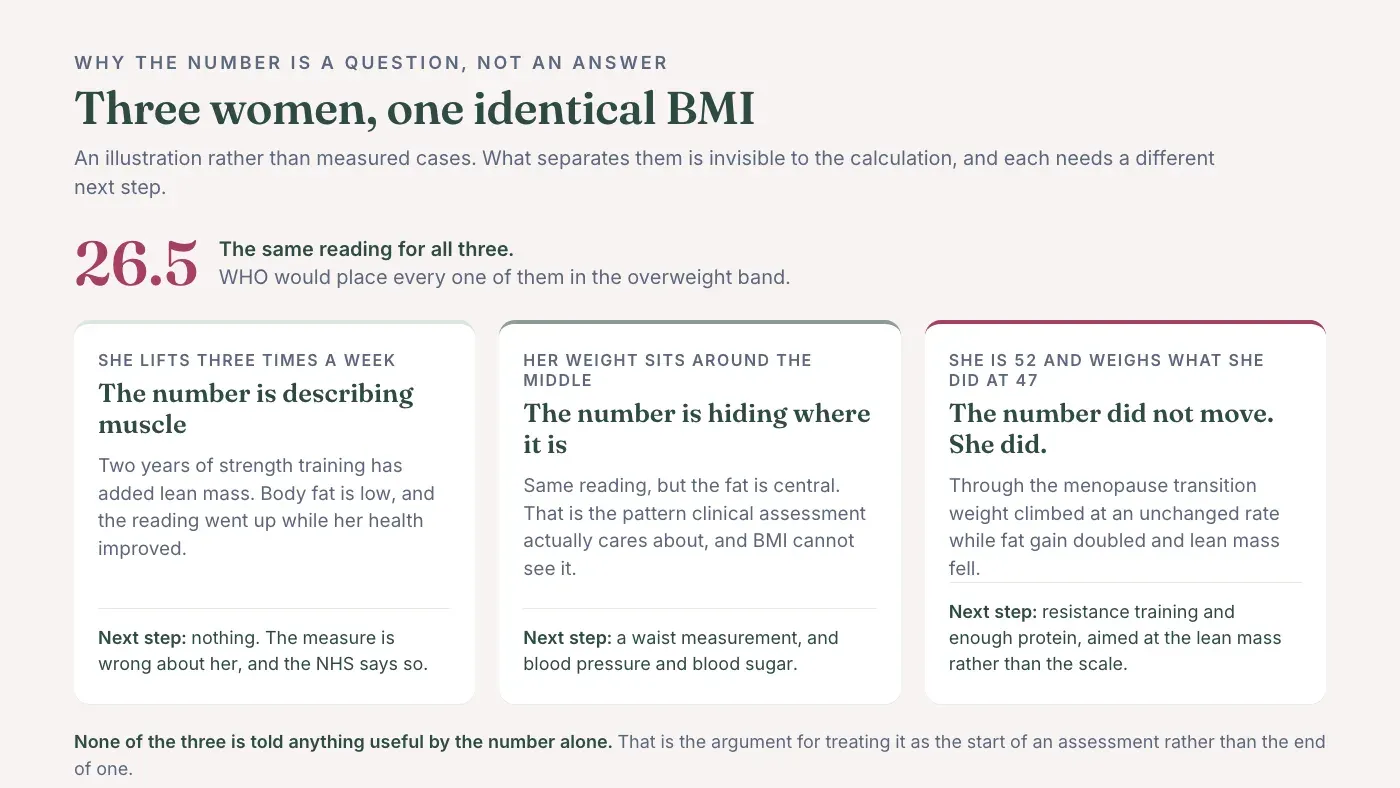
Muscle against fat. The NHS is blunt about this: the calculation cannot tell the difference, and if you have a lot of muscle you may be classed as overweight or obese despite having low body fat. Clinical reviews put the same point from both ends, noting that BMI overestimates fatness in people with a muscular build and underestimates it in older people (StatPearls). If you have been strength training for a year, your number moving up may be the training working.
Where the fat is. BMI has no idea. Fat around the middle carries different risk from fat elsewhere, and central fat is what clinical assessment actually cares about (StatPearls). Two women with identical BMIs can sit in quite different places on that scale.
What happens at menopause. This is the one most likely to catch a woman out. In the SWAN cohort, body weight climbed at the same steady rate through the menopause transition, with no acceleration, while the rate of fat gain doubled and lean mass began to fall (JCI Insight, 2019). Weight is the sum of two things moving in opposite directions, and BMI is built on weight.
Age. The same figure means something different at 30 and at 70, because the proportion of body weight that is muscle changes over a life.
What to measure alongside it
Your waist. WHO notes that waist measurement helps in assessing obesity, and clinical reviews call waist circumference a key indicator of central fat and the cardiometabolic risk that goes with it (WHO, StatPearls). Following the WHO protocol, measure midway between the lower edge of your last palpable rib and the top of your hip bone, standing after breathing out normally, with the tape level, snug and not compressing the skin. As with BMI, the thresholds differ by ethnic background, so ask what applies to you rather than using a chart you found.
Things that are not on any tape measure. Blood pressure, HbA1c or fasting glucose, and a lipid panel say more about metabolic health than body size does. A woman with a BMI of 27 and normal results is in a different position from a woman with the same number and a rising HbA1c. If you have PCOS or signs of insulin resistance, those numbers are the ones worth watching.
What is changing, rather than where you are. A single BMI is a snapshot. A number that has climbed steadily over three years is more informative than any one reading, and so is a number that has fallen without you trying, which is worth investigating rather than welcoming.
When BMI should not be used at all
The NHS says its adult calculator is not for use (NHS):
- During pregnancy
- If you have an eating disorder
- If you have a condition that affects your height
- If you are under 18, where the children's version applies instead
Those are not soft suggestions. Standard adult BMI categories are not used to assess healthy weight change during pregnancy, and in an eating disorder a number on a scale is rarely a neutral piece of information.
Working out your own
Weight in kilograms, divided by height in meters, divided by height in meters again.
A woman of 1.65 m weighing 68 kg: 1.65 squared is 2.7225, and 68 divided by that is 24.98. One more kilogram takes her to 25.3, across the line where WHO's overweight category begins. At the same height, 65 kg gives 23.9 and 72 kg gives 26.5.
A single kilogram moving you between categories should tell you something about how finely this instrument can really discriminate.
In pounds and inches, multiply weight in pounds by 703, then divide twice by height in inches.
What to do with the number
Use it as a prompt for a question, not as a verdict.
If your BMI sits in the healthy range and you feel well, it has done its job and there is nothing to act on. If it sits outside, the useful next step is a fuller picture rather than a diet decision: your waist, your blood pressure, your blood sugar, and what your number has been doing over years rather than what it is today. Our BMI calculator gives you the figure; this page is about what to do once you have it.
And if the number and your experience disagree, take the disagreement seriously in both directions. A reassuring BMI with rising blood sugar deserves attention, and an alarming BMI on a woman who lifts three times a week may be describing her muscle.
Frequently asked questions
What is a healthy BMI for a woman?
The WHO adult cut-offs are the same for women and men: overweight starts at a BMI of 25 and obesity at 30. There is no separate female scale. What does change the reading is your ethnic background, because the NHS notes that people from Asian, Black African, African-Caribbean or Middle Eastern backgrounds face a higher chance of health problems at a lower BMI.
Why does my BMI say overweight when I am fit?
Because the calculation cannot tell muscle from fat. The NHS states this directly: if you have a lot of muscle you may be classed as overweight or obese despite having low body fat. Two women of the same height and weight can have very different bodies and get the same number.
What should I measure alongside BMI?
Waist circumference. BMI says nothing about where fat sits, and fat around the middle carries different risk from fat elsewhere. WHO notes that waist measurement helps, and clinical reviews call it a key indicator of central fat. The thresholds themselves differ by ethnic background.
Does BMI work at menopause?
It works less well than you would think. In the SWAN cohort, body weight climbed at the same steady rate through the menopause transition while fat gain doubled and lean mass fell. A BMI that has not moved between 47 and 52 can sit on top of a body that has changed a good deal.
When should BMI not be used?
The NHS says the adult calculator is not for use during pregnancy, for people with an eating disorder, or for people with a condition affecting their height. Anyone under 18 needs the children's version instead.
References
- Calculate your body mass index (BMI) for adults · NHS
- Obesity and overweight · World Health Organization
- Secondary causes of obesity and comprehensive diagnostic evaluation · StatPearls, NCBI Bookshelf
- Changes in body composition and weight during the menopause transition · JCI Insight, 2019