Recurrent UTIs in women: what prevents them and what does not
Why UTIs keep coming back, what the trials say about cranberry and D-mannose, and the red flags that mean you should not wait it out.


Written and evidence-checked by the VeriNourish Editorial Team against 9 named sources listed below. No licensed clinician reviews this content.
If you have had three UTIs this year, you have probably been told to drink more water, wipe front to back, and try cranberry, and you may have found none of it made much difference.
Some of that advice is better than its reputation. In a randomized trial of 140 premenopausal women with recurrent cystitis who were drinking under 1.5 liters a day, adding 1.5 liters of water daily cut mean episodes over 12 months from 3.2 to 1.7 (JAMA Internal Medicine, 2018). That applies to women starting from a low fluid intake, and not to anyone advised to limit fluids for another condition.
What the standard list skips is the question that matters once infections repeat: why these keep happening to you, and which preventive options exist beyond drinking more.
Two in six months changes the question
The accepted definition is two or more infections in six months, or three or more in twelve months (NHS). Either pattern warrants a conversation with a doctor about prevention, not just treatment of the next episode.
Once you meet either definition, the conversation changes from treating this infection to preventing the next. Two things belong in it.
Confirming what is being treated. Repeated courses of antibiotics for symptoms that were never cultured is a common trap. A urine culture matters more with recurrence, both to guide the antibiotic and because persistent symptoms with negative cultures point at other causes that antibiotics will not fix.
Choosing a prevention strategy. NICE guidance for England considers behavioral measures, vaginal estrogen after menopause, methenamine and, when appropriate, single-dose or daily antibiotic prophylaxis. It calls for review of antibiotic prophylaxis within six months (NICE NG112). These are options to discuss with a doctor, not a fixed ladder or a universal treatment plan for every country.
Cranberry: real but small, and smaller than it looks
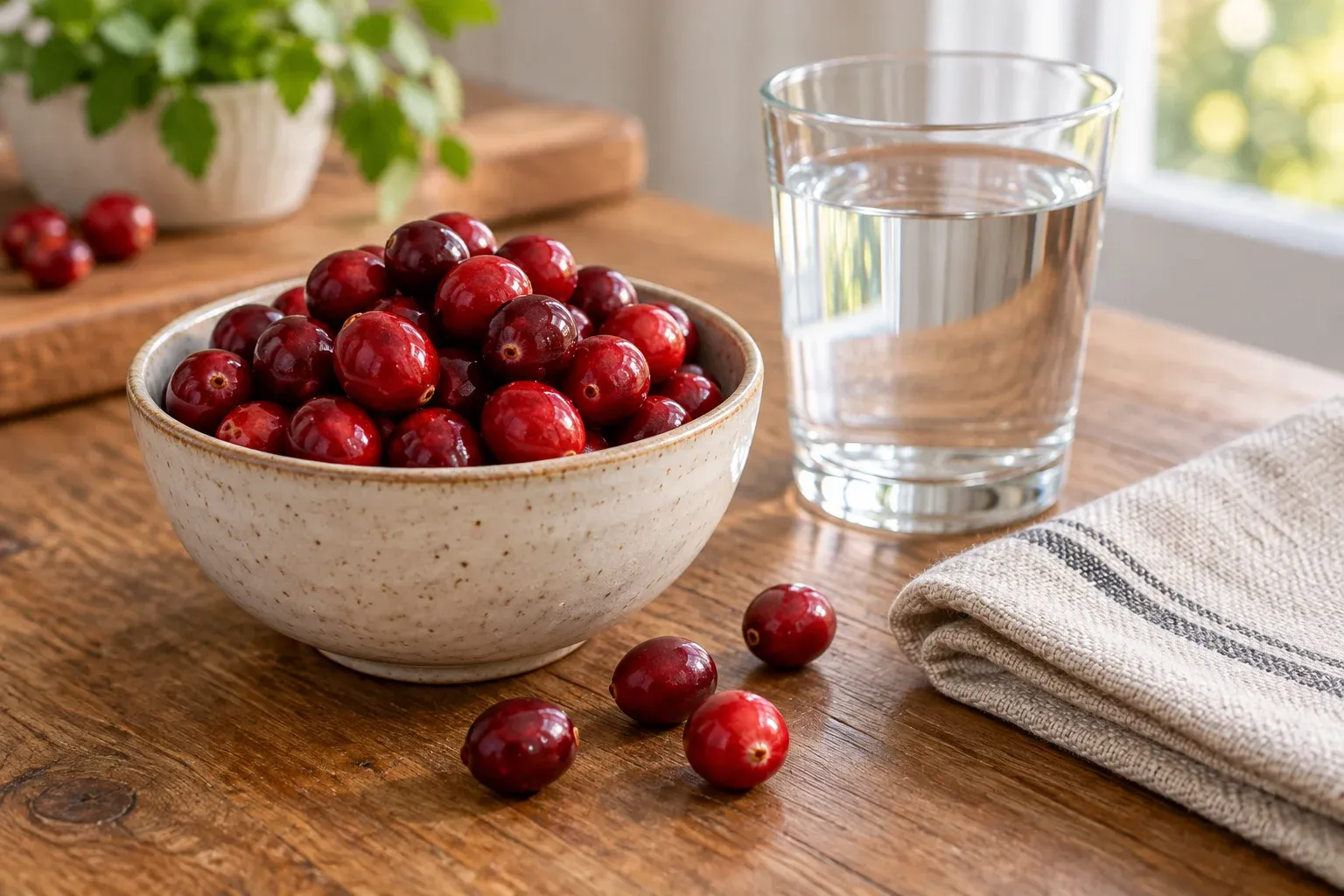
Cranberry is the most studied of the self-care options, which means we can be precise about how well it works.
The 2023 Cochrane review found that cranberry products probably reduce symptomatic, culture-verified UTIs in women with recurrent infections: eight studies, 1,555 participants, risk ratio 0.74 with a confidence interval of 0.55 to 0.99, at moderate certainty. On that basis the review supports their use in this group (Cochrane, 2023). In plain numbers that came out as 18% of women on cranberry having an infection against 24% on placebo, across studies following participants for between one and twelve months (Canadian Family Physician, 2024). Those are averages across different products and doses rather than a promise attached to any particular bottle.
A more skeptical reading exists alongside it. A Canadian Family Physician summary points to possible publication bias, small studies and unblinding, and cites a separate systematic review in which adjusting for missing studies moved the relative risk from 0.68 to 0.83 (Canadian Family Physician, 2024). That adjustment comes from a different analysis rather than a recalculation of the eight trials above, so treat it as a reason for caution rather than a corrected figure.
The benefit also does not hold across every group: it was not statistically different from placebo in institutionalized older patients or in pregnant women (Canadian Family Physician, 2024).
Either way it is prevention, not treatment. The NHS is explicit that there is no evidence cranberry eases symptoms once an infection has started, and it advises anyone taking warfarin to avoid cranberry products (NHS).
D-mannose: what the trial found
D-mannose has been promoted on the theory that it stops bacteria adhering to the bladder wall.
It was tested properly. A randomized trial gave 598 women with recurrent UTIs either 2 g of D-mannose powder daily or placebo for six months. A further clinically suspected UTI occurred in 51.0% on D-mannose and 55.7% on placebo, a risk difference of −5% with a confidence interval running from −13% to 3% (JAMA Internal Medicine, 2024).
The interval crosses zero, so the trial did not establish a benefit. The authors' conclusion was direct: D-mannose should not be recommended to prevent future episodes of medically attended UTI in women with recurrent UTI in primary care (JAMA Internal Medicine, 2024).
That is a finding about this dose, in this population, for this outcome, rather than proof that D-mannose does nothing at any dose. It is still the best evidence available, and it is worth knowing before you spend another six months on it.
Menopause is the risk factor people miss
The NHS lists being post-menopausal among the risk factors for UTI, alongside pregnancy, kidney stones, catheter use and a weakened immune system (NHS).
The mechanism is the same one behind vaginal dryness. Falling estrogen thins and changes the tissue of the vagina and urethra, which shifts the local bacterial balance and makes infection easier to establish. It is a genuine physiological change, not bad luck or poor hygiene.
If your UTIs started or worsened in your forties or fifties, say so at your appointment; it changes which preventive options are on the table. Our guide on vaginal dryness and genitourinary syndrome of menopause covers the tissue changes involved, and menopause covers the wider transition.
Two prescribed options the supplement aisle does not mention
Neither of these is something to start on your own, and both belong in a conversation with a doctor.
Vaginal estrogen. For women after menopause, treating the tissue changes directly is a recognized preventive option. A meta-analysis of five trials in 1,936 women found a pooled relative risk of 0.42 for recurrent UTI with vaginal estrogen versus placebo. Three separate trials of oral estrogen did not find a benefit (International Urogynecology Journal, 2021). This is local treatment, and it is a different decision from systemic HRT.
Methenamine hippurate. A non-antibiotic option that NICE includes as an alternative to daily antibiotic prophylaxis for suitable patients. In the ALTAR trial, 240 women were randomized and methenamine was non-inferior to prophylactic antibiotics over 12 months (BMJ, 2022). Non-inferior means it stayed within a pre-agreed margin of the comparison, not that the infection rates were identical.
Two limits worth knowing. This route is usually for women who are not pregnant, after any active infection has been treated; pregnancy, and recurrences that are complicated or involve the kidneys, need specialist advice. And methenamine works in acidic urine, so citrate sachets taken to soothe cystitis can undermine it. It is a preventive and does not treat an infection you have now.
What about probiotics
The Cochrane review compared cranberry products against probiotics and found cranberry reduced the risk of symptomatic, culture-verified UTIs relative to them (Canadian Family Physician, 2024).
That is a comparison between two options, not proof that either is effective. Our probiotics guide covers where the evidence for them is stronger, and this is not one of those places.

When not to wait it out
These are three different situations, and they need different responses.
Get emergency help if you have a UTI alongside confusion, unusual drowsiness, difficulty speaking, or you become very unwell quickly. Those can signal a serious infection (NHS).
Be seen urgently, the same day, if you have:
- Pain in your back or side, just under the ribs
- A very high temperature, or a temperature that is unusually low, with shivering
- Symptoms that are getting worse rather than better
- Blood in your urine, or pain low in your tummy, which need assessment even though neither on its own proves the infection has reached the kidneys
- Symptoms of a UTI while pregnant. This is not something to watch; get a same-day assessment
Contact your doctor if your symptoms have not started to improve within 48 hours of beginning treatment or self-care. That is a separate situation from the ones above: rapid worsening does not wait 48 hours (NHS).
Separately from any current infection, book an appointment to discuss the pattern if you have had two or more infections in six months or three or more in twelve, or if recurring symptoms started after menopause.
What is actually worth doing
Hydration is worth taking seriously if you are currently drinking little, on the trial evidence above, alongside ordinary hygiene (NHS). Cranberry has moderate-certainty evidence behind it for women with recurrent infections, with a modest effect size, and is not for anyone taking warfarin. D-mannose was tested properly and did not show a benefit.
The step with the most behind it is the least product-shaped one: once you meet the definition of recurrent infection, get the pattern assessed rather than treating each episode alone. Culture to confirm what is being treated, vaginal estrogen after menopause, methenamine, and antibiotic prophylaxis are all decisions that need a doctor, and between them they carry far more evidence than anything you can buy without one.
This is general information about a common condition, not a diagnosis or a treatment plan. A UTI that is not improving needs medical assessment, and nothing here replaces that.
Frequently asked questions
What counts as a recurrent UTI?
Two or more infections within six months, or three or more within twelve. If you meet either threshold, speak with a doctor about the pattern and prevention rather than treating each episode on its own.
Does cranberry actually work?
Modestly. The 2023 Cochrane review found cranberry products probably reduce symptomatic, culture-verified UTIs in women with recurrent infections, at moderate certainty, with a risk ratio of 0.74 across eight trials in 1,555 participants. In absolute terms that was 18% against 24% on placebo, across studies following people for one to twelve months. It prevents rather than treats, and the NHS advises anyone taking warfarin to avoid cranberry.
Is D-mannose worth taking?
The largest placebo-controlled trial did not find a benefit. In 598 women with recurrent UTIs, 2 g of D-mannose daily for six months produced 51.0% with a further UTI against 55.7% on placebo, a difference that was not statistically significant, and the authors concluded it should not be recommended for this purpose. That is a finding about this dose and population rather than proof of no effect at all.
Why do UTIs get more common after menopause?
Falling estrogen thins and changes the tissue of the vagina and urethra, which alters the local bacterial balance and makes infection easier. The NHS lists being post-menopausal as a risk factor. It is also treatable: vaginal estrogen is a recognized preventive option, with a pooled relative risk of 0.42 across five trials, so it is worth raising specifically with your doctor.
When is a UTI an emergency?
Confusion, unusual drowsiness, difficulty speaking or becoming very unwell quickly need emergency help. Pain in your back under the ribs, a very high or unusually low temperature, worsening symptoms, blood in your urine, or any UTI symptoms in pregnancy need prompt assessment. Not improving within 48 hours of starting treatment is a reason to contact your doctor, and it is not a waiting period for the signs above.
References
- Urinary tract infections (UTIs) · NHS
- Cranberries for prevention of UTIs · Canadian Family Physician, 2024
- d-Mannose for Prevention of Recurrent Urinary Tract Infection Among Women: A Randomized Clinical Trial · Hayward G, JAMA Internal Medicine, 2024
- Cranberries for preventing urinary tract infections · Cochrane Database of Systematic Reviews, 2023
- Update to the management of recurrent urinary tract infections in women aged 16 years and older · Drug and Therapeutics Bulletin, 2026
- Effect of Increased Daily Water Intake in Premenopausal Women With Recurrent Urinary Tract Infections: A Randomized Clinical Trial · Hooton TM, JAMA Internal Medicine, 2018
- Urinary tract infection (recurrent): antimicrobial prescribing, recommendations · NICE, 2024
- Estrogen for the prevention of recurrent urinary tract infections in postmenopausal women: a meta-analysis of randomized controlled trials · International Urogynecology Journal, 2021
- Alternative to prophylactic antibiotics for the treatment of recurrent urinary tract infections in women: multicentre, open label, randomised, non-inferiority trial · BMJ, 2022