Vaginal dryness and GSM: what actually helps
Vaginal dryness at menopause can also affect the bladder. See what helps, where vaginal estrogen fits, and when symptoms need medical assessment.

Written and evidence-checked by the VeriNourish Editorial Team against 6 named sources listed below. No licensed clinician reviews this content.
Most women meet this symptom as dryness, and most articles stop there. The condition it belongs to is wider than that, and the wider version explains things that otherwise look unconnected: the sudden urgency, the stinging when you pee, the third urinary infection in a year.
If you take one thing from this page, take that. Then take a practical second point: an over-the-counter lubricant or moisturizer is a reasonable first step for uncomplicated dryness, while persistent or urinary symptoms deserve a treatment discussion.
It has a name, and the name is the point
In 2014 two professional societies replaced the old term "vulvovaginal atrophy" with genitourinary syndrome of menopause, or GSM. The change was not cosmetic. The agreed definition covers the labia, clitoris, vestibule, vagina, urethra and bladder, and it groups three sets of symptoms together (Menopause, 2014):
- Genital: dryness, burning, irritation
- Sexual: poor lubrication, discomfort or pain, impaired function
- Urinary: urgency, pain when passing urine, recurrent urinary tract infections
You may have some of these and not others. The consensus panel added one condition that matters: the symptoms have to be bothersome to you, and they should not be better explained by something else.
The practical value of the grouping is that women who would never book an appointment about dryness will book one about a third urinary infection, and often nobody connects the two.
What else causes it
Menopause is the most common cause and not the only one. The NHS also names pregnancy and breastfeeding, hormonal contraception, antidepressants, hysterectomy especially where the ovaries were removed, cancer treatment including chemotherapy and radiotherapy, lack of arousal, perfumed soaps and douches, and conditions such as diabetes and Sjogren's syndrome (NHS).
That list matters for women in their thirties who assume this cannot be them. It also matters because two of the causes are things you can change without a prescription.
Lubricant, moisturizer, prescription: what does what
| Option | Used when | What it does |
|---|---|---|
| Lubricant | At the time, for sex | Reduces friction immediately. Effect lasts as long as the activity |
| Vaginal moisturizer | Regularly, every few days | Changes how the tissue feels day to day, independent of sex |
| Vaginal estrogen, DHEA or ospemifene | On prescription, when the above are not enough | Acts on the tissue itself. Vaginal estrogen is the option with the urinary evidence behind it |
The NHS suggests water-based lubricants before sex, vaginal moisturizers for the dryness itself, unperfumed soap around the vulva, and more time for arousal (NHS). NAMS puts prescription options after that: for GSM symptoms not relieved by over-the-counter treatment, in women who do not need systemic hormone therapy for other reasons, low-dose vaginal estrogen or alternatives such as vaginal DHEA or oral ospemifene are recommended (Menopause, 2022).
The uncomfortable trial result
Here is the finding that should change how you spend money on this, and that most menopause writing leaves out.
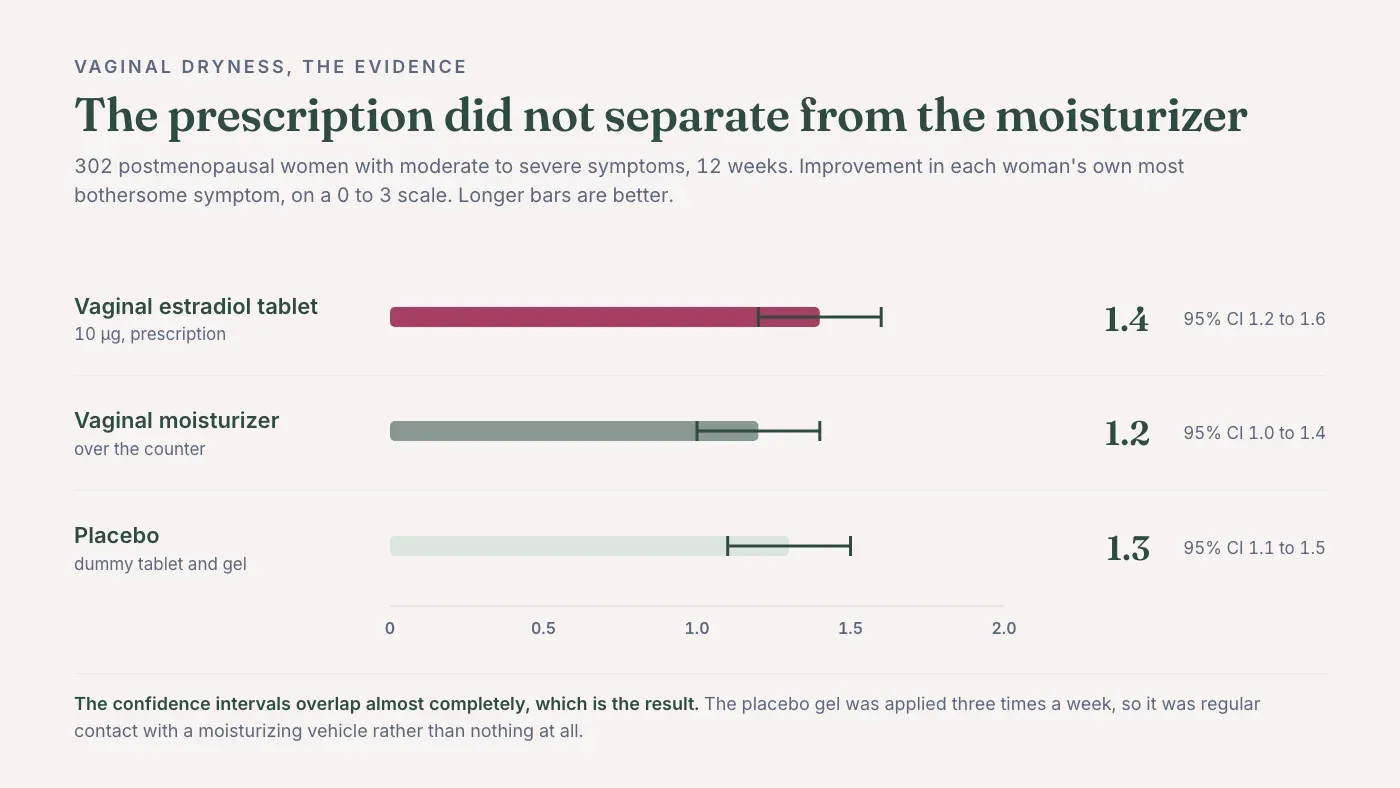
A randomized trial gave 302 postmenopausal women with moderate to severe symptoms one of three things for 12 weeks: a low-dose vaginal estradiol tablet, an over-the-counter vaginal moisturizer, or a dual placebo. Improvement in each woman's most bothersome symptom was almost identical in all three groups: −1.4 with estradiol, −1.2 with the moisturizer, −1.3 with placebo, on a 0 to 3 scale. Sexual function scores told the same story (JAMA Intern Med, 2018).
Older pooled evidence is more favorable to local estrogen. A Cochrane review of 30 trials in 6,235 women found more women reporting improvement with an estrogen ring or tablet than with placebo, but rated the evidence low quality, and for tablets the result held only under one statistical model and not the other (Cochrane, 2016).
Two honest readings of that. The placebo in the 2018 trial was a gel applied three times a week, so "placebo" meant regular contact with a moisturizing vehicle rather than nothing at all. And 12 weeks is a short window. The trial supports starting with an over-the-counter option for uncomplicated dryness, but it was not designed to prove the three treatments equivalent. Pooled evidence and guidelines still support local estrogen when symptoms persist.
Where vaginal estrogen clearly earns its place
The urinary side is a different story, and it is the strongest evidence in this whole area.
A meta-analysis pooled eight randomized trials in 4,702 postmenopausal women with recurrent urinary tract infections. Across five trials in 1,936 women, vaginal estrogen cut recurrence, with a relative risk of 0.42. Across three trials in 2,766 women, oral estrogen did nothing, with a relative risk of 1.11 and a confidence interval spanning no effect (Int Urogynecol J, 2021).
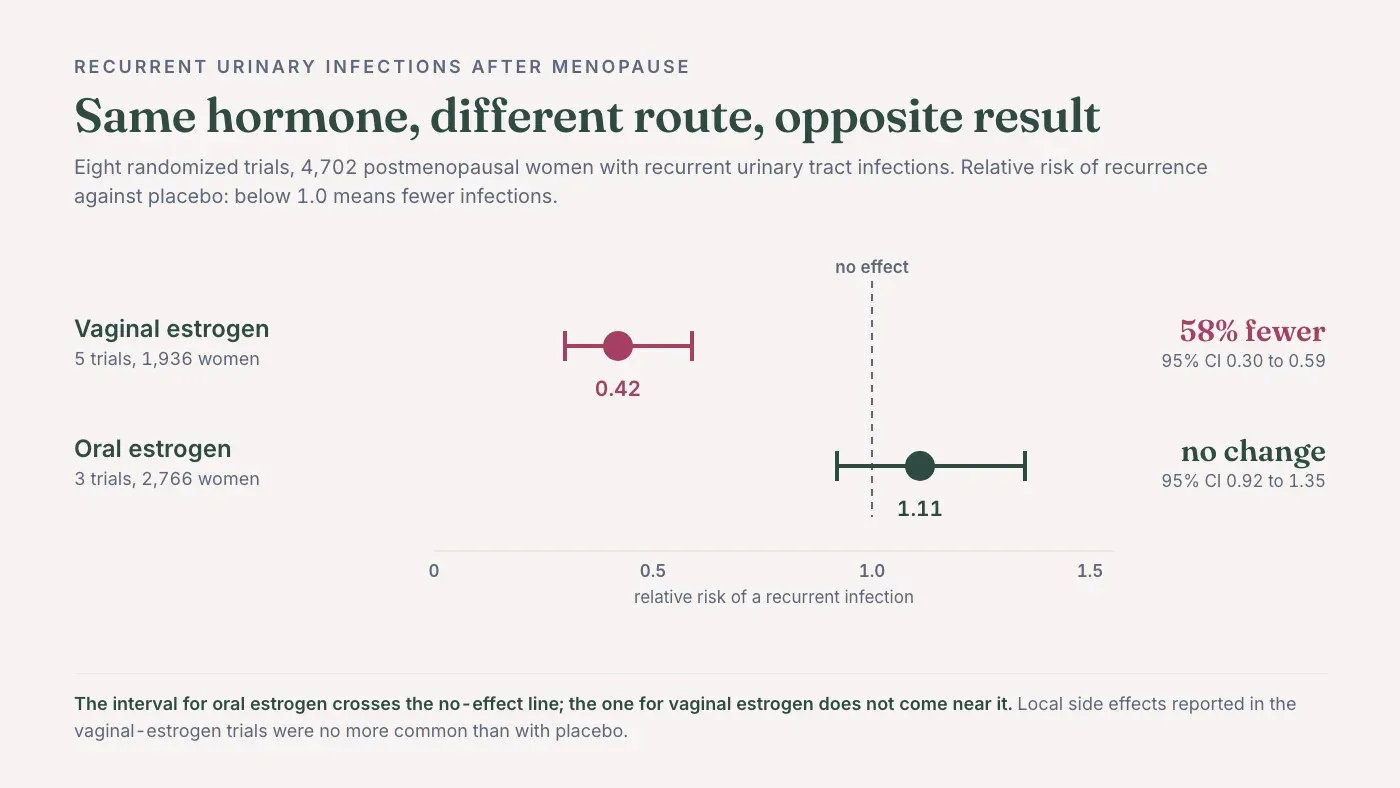
The two pooled estimates came from separate sets of trials, so they do not prove that route alone caused the difference. They do show evidence of benefit for vaginal estrogen and no demonstrated benefit for oral estrogen in this setting. If you are having repeated urinary infections after menopause, raise that symptom specifically because this is where the evidence for vaginal estrogen is strongest.
Reported side effects of vaginal estrogen in those trials were local: discomfort, irritation, burning and itching, and they were not more common than with placebo.
What to do, in order
- Switch to unperfumed soap around the vulva, and stop any douching. Free, and one of the NHS's first suggestions.
- Add a lubricant for sex and a moisturizer for the rest of the week. They are not substitutes for each other.
- Give it a few weeks. If the symptoms are unchanged, that is the point at which a prescription conversation is justified rather than premature.
- Raise urinary symptoms by name. Urgency, stinging and repeat infections are part of GSM, but they also have other causes that need assessment.
Systemic HRT treats GSM too, and NAMS calls hormone therapy the most effective treatment for both hot flashes and GSM. If you are already considering HRT for hot flashes or other perimenopause symptoms, this belongs in the same conversation rather than a separate one. If dryness and urinary symptoms are your only complaint, the local options exist precisely so you do not need the systemic one.
If you have unexplained vaginal bleeding, a history of an estrogen-sensitive cancer, or are receiving treatment such as an aromatase inhibitor, discuss vaginal hormone treatment with the clinician managing your care. The choice should reflect your symptoms, medical history and preferences.
When to see a doctor
Book an appointment if self-help has not helped after a few weeks, or if the symptoms are affecting your daily life. You do not need to have tried everything first.
See a doctor rather than treating it at home if you have (NHS):
- Unusual vaginal discharge
- Bleeding after sex, or spotting between periods
- Any bleeding at all after your periods have stopped
Discomfort during sex is also one of the most common and most fixable reasons interest fades, which our guide to low libido covers from the other direction. Treating the pain often does more for desire than anything aimed at desire itself.
Frequently asked questions
Is vaginal dryness at menopause just about sex?
No, and that is the most useful thing to know about it. The condition is called genitourinary syndrome of menopause because the same estrogen drop affects the vulva, vagina, urethra and bladder. Alongside dryness and discomfort it can bring urinary urgency, pain when peeing, and repeated urinary infections.
Do I need a prescription, or will a moisturizer do?
For uncomplicated dryness, an over-the-counter lubricant or moisturizer is a reasonable first step. In one 12-week trial, symptoms improved by similar amounts with low-dose vaginal estradiol, moisturizer and placebo gel, but that trial was not designed to prove the treatments equivalent. NAMS recommends prescription options when over-the-counter treatment has not relieved symptoms.
What is the difference between a lubricant and a moisturizer?
A lubricant is used at the time, to reduce friction during sex, and its effect is immediate and temporary. A vaginal moisturizer is used regularly, every few days, to change how the tissue feels day to day. They solve different problems and many women use both.
Does vaginal estrogen help recurrent urinary infections?
This is where the evidence is strongest. Pooling five randomized trials in 1,936 postmenopausal women, vaginal estrogen reduced recurrent urinary tract infections by more than half. A separate pool of three oral-estrogen trials in 2,766 women did not show a benefit. These were separate trial groups, not a head-to-head route comparison.
What else causes vaginal dryness besides menopause?
The NHS names pregnancy and breastfeeding, hormonal contraception, antidepressants, hysterectomy especially with removal of the ovaries, cancer treatments, lack of arousal, perfumed soaps and douches, and conditions such as diabetes and Sjogren's syndrome. Menopause is the most common cause, not the only one.
When should I see a doctor about it?
See a GP if self-help has not worked after a few weeks, if the dryness is affecting your daily life, or if you have unusual discharge, bleeding after sex, or any bleeding at all after your periods have stopped. Those last three need checking rather than treating at home.
References
- Genitourinary syndrome of menopause: new terminology for vulvovaginal atrophy from ISSWSH and NAMS · Menopause, 2014
- Efficacy of vaginal estradiol or vaginal moisturizer vs placebo for treating postmenopausal vulvovaginal symptoms: a randomized clinical trial · JAMA Internal Medicine, 2018
- Local oestrogen for vaginal atrophy in postmenopausal women · Cochrane Database of Systematic Reviews, 2016
- Estrogen for the prevention of recurrent urinary tract infections in postmenopausal women: a meta-analysis of randomized controlled trials · International Urogynecology Journal, 2021
- The 2022 hormone therapy position statement of The North American Menopause Society · Menopause, 2022
- Vaginal dryness · NHS