Choline during pregnancy: food, prenatal labels and supplements
How much choline pregnancy requires, what eggs and other foods provide, and why a prenatal vitamin may not cover it.

Written and evidence-checked by the VeriNourish Editorial Team against 4 named sources listed below. No licensed clinician reviews this content.
Your prenatal vitamin can list folic acid and vitamin D yet contain little or no choline. That does not mean you need another pill. It means the food you eat and the amount on the label both belong in the conversation.
The US adequate intake for pregnancy is 450 mg of choline a day, counting food and supplements together. “Adequate intake” is the name of a reference value used when there is not enough evidence to set a recommended dietary allowance. It is not a dose to take in addition to a normal diet (NIH Office of Dietary Supplements).
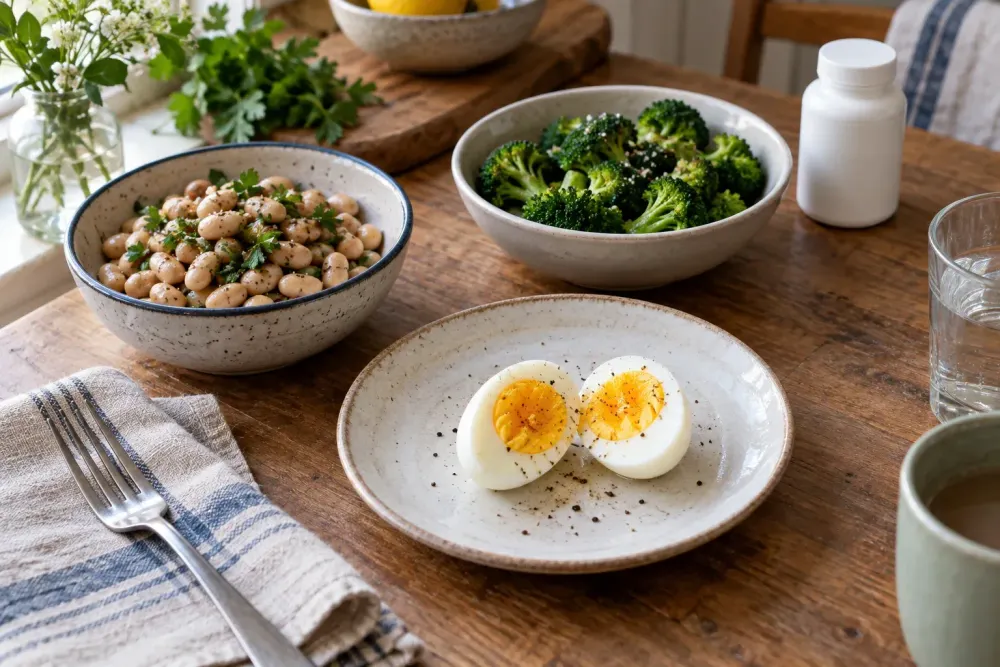
Cover illustration: Food counts toward the daily choline intake. A prenatal label tells you whether its contribution is small or absent.
Start with the food you already eat
Eggs are a useful example because the yolk contains much of the egg's choline. The NIH food table lists a large hard-boiled egg at 147 mg and a half cup of roasted soybeans at 107 mg. Three ounces of roasted chicken breast contribute 72 mg; a half cup of canned kidney beans contributes 45 mg. These are examples rather than a prescribed menu, and values vary with serving size (NIH ODS food table).
If eggs, meat and fish are not in your diet, do not assume one serving of beans replaces an egg gram for gram. Soybeans, beans, some grains and vegetables contribute, but a day of plant-based eating may take more planning. Bring a typical day's meals to your clinician or registered dietitian rather than guessing that one food solves the question. Our pregnancy nutrition guide covers the wider diet; this page is about choline specifically.
Read the amount, not the front of the bottle
Some prenatal products contain choline and some do not. NIH ODS notes that products marketed for prenatal use often contain little or none; the number to compare is the milligrams of choline per daily serving in Supplement Facts, not a claim such as “supports brain development” on the package (NIH ODS).
Add that number to a realistic estimate of your usual food. Do not treat a single low-food day as a diagnosis of deficiency. If nausea, food restrictions or a vegan diet make meeting the adequate intake difficult, ask your pregnancy care team whether a different prenatal or a separate supplement makes sense. Tell them what you already take so the products can be reviewed together.
What the evidence can and cannot promise
Choline is involved in cell membranes and nervous-system development (NIH ODS). Human trials of maternal choline supplementation have reported mixed results on specific infant cognitive outcomes. One small trial found faster infant information processing; another found no improvement in the cognitive measures studied. Their protocols and outcomes differed, and they do not establish a guaranteed benefit for an individual child (Caudill et al.; Cheatham et al.).
Do not replace your folic acid with choline. Folic acid has specific preconception and early-pregnancy advice for neural tube defect prevention. Choline is a separate dietary question, and the two numbers on a supplement label cannot be swapped.
Too much choline can also cause adverse effects. The US adult upper limit is 3,500 mg a day from all sources, a ceiling rather than a goal; NIH ODS lists fishy body odor, vomiting, excessive sweating and low blood pressure among possible effects of high intakes. There is no reason to aim for that ceiling (NIH ODS).
After delivery, the reference intake changes to 550 mg a day during lactation. CDC also asks clinicians to pay attention to choline and iodine in the diets of people who are breastfeeding. That is a separate stage with a different intake value, not a reason to double your pregnancy supplement now (NIH ODS; CDC).
If you are pregnant and struggling to eat regularly, have a restricted diet, or are unsure how several supplements add up, take the labels to your next prenatal visit. The useful question is whether your usual diet and prenatal together are likely to cover your needs, without adding a high-dose product on your own.
Frequently asked questions
Is 450 mg of choline a supplement dose?
No. It is the adequate intake from food and supplements combined for pregnancy, not a prescription to take a 450 mg pill.
Does folic acid replace choline?
No. Both nutrients matter, but folic acid has established guidance to reduce neural tube defects. Keep taking any folic acid prescribed or recommended to you.
Do I need a separate choline supplement?
Not everyone does. Check your usual foods and the amount on your prenatal label with your pregnancy care team before adding a product.
References
- Maternal choline supplementation during the third trimester of pregnancy improves infant information processing speed · Caudill et al., FASEB Journal, 2018
- Phosphatidylcholine supplementation in pregnant women consuming moderate-choline diets does not enhance infant cognitive function · Cheatham et al., American Journal of Clinical Nutrition, 2012
- Choline: Health Professional Fact Sheet · NIH Office of Dietary Supplements
- Maternal Diet and Breastfeeding · Centers for Disease Control and Prevention